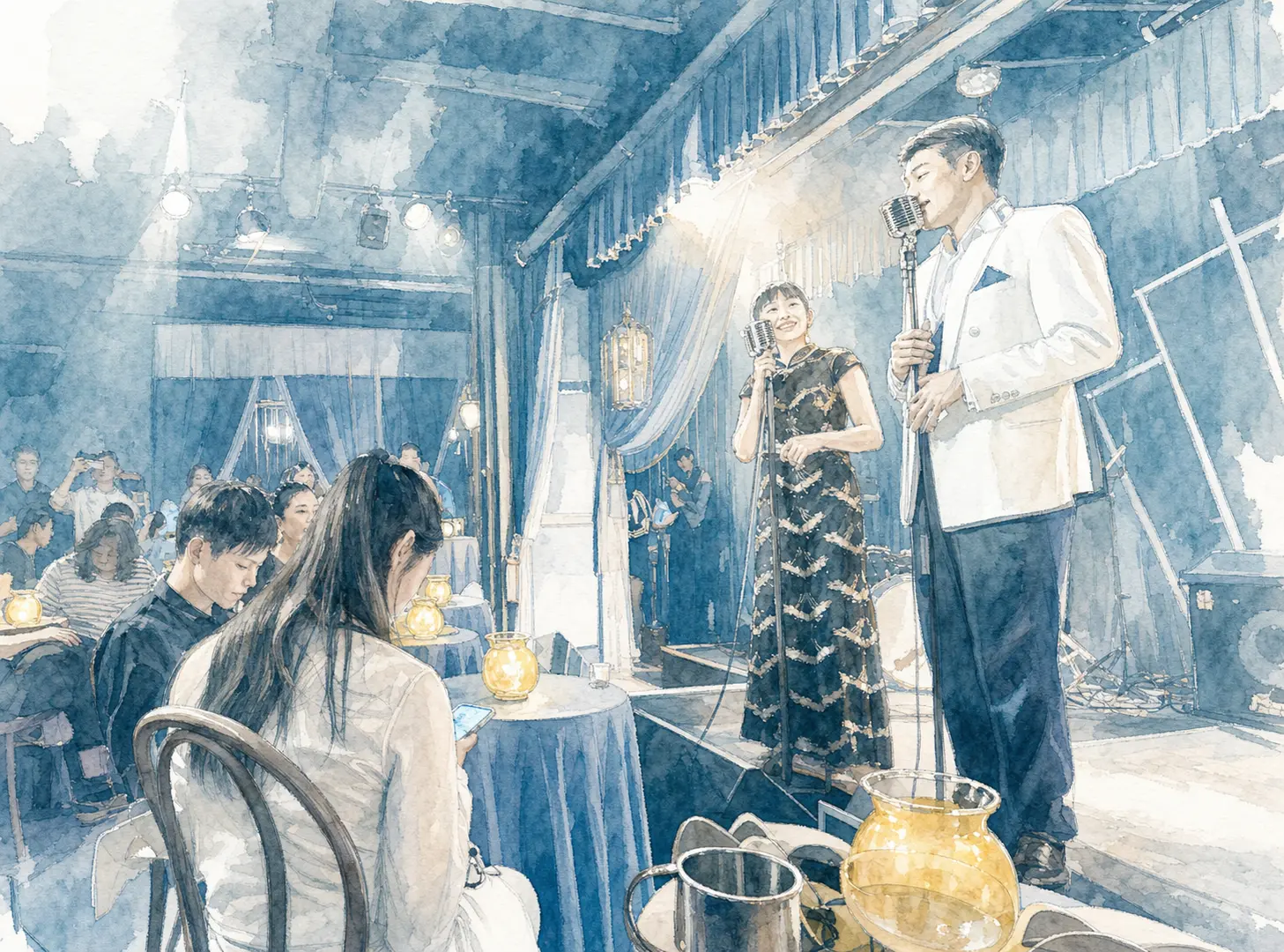
While sorting through old photographs, I suddenly came across one taken many years ago at Sleep No More in Shanghai. Red curtains hang low and light settles at the centre of the stage. Two singers stand before vintage microphones while music seems to move slowly behind them. Around small tables, people talk, raise their glasses, or simply watch.
The photograph has kept that night where it was, while I, beyond its frame, have travelled far through time. Memory often rests quietly below awareness until a beam of light or an indistinct figure wakes it. For a moment, time opens a narrow seam and an earlier self looks back.
It is difficult to decide whether the place in the photograph is a hotel, a theatre, or a dream briefly detached from ordinary life. This is Sleep No More in Shanghai.
Inside the McKinnon Hotel, the familiar rules of watching no longer apply. There is no assigned seat and no curtain between performer and audience. Behind a white mask, each person moves through dark corridors and rooms: open one door and you may interrupt a secret; follow a passing figure and you enter another current of fate.
Some follow Macbeth down a corridor, some remain in a room everyone else overlooks, and others meet a performer only for an instant at a staircase. No two people witness quite the same story. Macbeth begins with desire and killing: prophecy enters the mind, ambition, fear, and guilt gather around it, and everyone is drawn into fate's undertow.
Yet those rooms held more than an old tragedy. The masked audience appears free to choose whom to follow, where to pause, and when to turn away. Still, none of us can see the whole. At one particular moment, we open one door and meet one person.
Life is much the same. We imagine ourselves at the centre, certain why the story began and where it should go. Years later, we realise that we too saw only limited light through a narrow opening. We may share years of another person's story without fully reading it; the weight behind a silence sometimes becomes clear only after the chance to answer has passed.
We are both performers and spectators. When young, we want the centre of the stage and wait for the light to fall on us. Later we learn that light belongs to no one. It moves towards a partner, a child, a friend, and those who enter our lives by accident before quietly leaving.
The roles keep changing. The person who seemed certain becomes lost; the one who was protected begins to protect someone else; the person once silent in the crowd one day stands before a microphone.
Those we imagined beside us until the final curtain may release our hand at some unnoticed turn. There is no farewell and no applause. One day we simply realise that they have disappeared into the immense crowd.
Memory keeps fragments: a road walked side by side, a late conversation, a glass left to cool, a line of light through a window. Like clues scattered through the hotel's rooms, they rest below the surface until a piece of music brings them back.
Sometimes I wonder whether opening another door, following another person, or speaking another sentence would have made a different life. Perhaps it would. But life offers no second entry. Everything that has happened moves away like water; even when we cross a similar landscape, it is no longer the same surface.
Perhaps all we can do is pass more attentively through the scene before us: see the faces beside us while the lights are on, hear what remains unspoken while the music continues, and treasure the brief sound of footsteps moving together.
When the performance ends, people remove their masks and return to the bar. Beneath red curtains, the singing continues. Pursuit, desire, betrayal, and death remain in the hotel's depths while people drink, talk, and smile as though returning from someone else's life.
Standing among them, I think that perhaps we have removed only the masks supplied by the theatre. Outside the doors, we still play child, partner, friend, and stranger, moving between meeting and farewell without ever seeing the whole story.
Yet sometimes, within a beam of light or a passage of music, we pause. We see who we once were and those who have already travelled beyond our sight.
Life may be theatre, but its script is never written in advance. We perform while searching for direction; we lose while learning to treasure what remains. In the end, what moves us is not who stood at the centre, but that within a limited span of time someone shared the scene and walked beside us. In the vast human tide, we truly saw one another.