Ⅰ. Steam from the Porcelain, and the First Ocean Swell
Along the lip of the white porcelain cup ran a delicate fillet of gilded gold. A faint curl of steam rose from the surface of the dark coffee, unfurling in the afternoon sun like an elusive ribbon of smoke.
My neighbor David sat across from me at the timber table. A Jewish gentleman in his seventies, his silver-gray hair caught the amber light with a soft, brushed luster. In eyes that had witnessed more than half a century of wandering and quiet sedimentation, there was the deep, patient composure of a fatherly figure. He rested his small silver spoon against the saucer with a gentle, crystalline clink.
"Jun," he asked in a low voice, measured as if turning the page of an ancient codex, "when you are down there dozens of meters beneath the sea, holding your breath... what does it actually feel like?"
The ring of silver against porcelain lingered, echoing strangely through the room.
In that single suspended second, the rising steam and the muted murmur of the cafe dissolved into the vast, briny chill of open water.
The scene cut away—swift, brutal, and elegant.
No streets. No cafe tables. I was adrift atop the boundless indigo expanse of the ocean.
Beside me, the yellow freediving float rocked gently with the deep-ocean swell. A three-millimeter rubber wetsuit gripped my ribs and joints like a second, airtight skin. My lower body hung submerged in twenty-six-degree water; at my ankles, a pair of ninety-centimeter carbon-fiber blades dangled into the abyss, catching the sunbeams with the dark luster of polished obsidian.
On land, the lungs expand and collapse automatically every two and a half seconds—the cheapest, yet most exorbitant gift bestowed upon mammals: over twenty thousand unconscious breaths a day.
Yet here, I was about to sever that invisible umbilical cord.
Before me plunged a single ten-millimeter braided rope, spearing straight toward the center of the earth. Forty-two meters. Equivalent to a fourteen-story skyscraper inverted into the deep; bearing the crushing weight of more than five atmospheres; meaning that for the next two minutes and twenty seconds, my entire flesh, memory, fear, and love would be staked upon a single breath held inside my ribs.
Ⅱ. Dust in the Workshop, and the Twilight Threshold
A sudden close-up. Macro focus.
I lay on my back upon the rolling surface, mask pushed up onto my forehead, eyes shut.
My ears dipped beneath the surface tension; every hollow slosh of the swell was amplified into a deep, cathedral drumbeat. My safety buddy floated just two meters away, the tiny flutter of his snorkel spitting drops into the sun.
A subtle, authentic prickle of anxiety stirred within my chest: I did not want to keep him waiting in the water too long. Waiting in the open ocean leaches heat and invites distraction. And so, an intricate emotional cocktail began to swirl: a touch of impatience about my teammate’s time, a touch of biological dread facing forty-two meters of void, and the residual stiffness of muscles not yet fully tamed.
I knew that to fight tension with sheer willpower in the deep ocean was an invitation to disaster.
The more one forces calmness, the louder the sympathetic nervous system screams, sending the pulse racing. I folded my breath into a deliberate, rhythmic square:
Inhale, four seconds. Hold, four seconds. Exhale, four seconds. Hold, four seconds.
Within that hypnotic geometric cycle, memory dissolved into a sudden cinematic flashback—
An afternoon years ago in an old workshop. A broom sweeps across the rough concrete floor, kicking up a golden haze of suspended dust motes; or a clear mountain stream where a careless child stomps the gravel, sending clouds of silt and clay swirling through the water until the transparency turns amber and murky.
How did one make the water clear again?
The answer was: Do nothing. Do not churn it. Do not filter it.
Let the silt settle. Down. Down. Grain by grain.
Throughout our secular lives, most of what we are taught is how to apply force, how to compete, how to clench our fists tighter. We live under the illusion that if we do not hustle, if we do not worry, if we leave a single crease of our schedules unfilled, life will slip through our fingers into chaos. Yet beneath these vast, rolling waters, existence reveals an entirely unarmored truth: the deepest discipline is never grasping, but enduring chaos; the greatest strength is not resistance, but waiting quietly as the sediment settles to the floor.
Here upon the open sea, my anxieties, fears, and stray thoughts were those very grains of disturbed sediment. Guided by the slow swing of the square breath, my consciousness drifted toward a liminal borderland—not unconscious slumber, but the hypnagogic twilight suspended precisely between waking and dreaming.
My limbs turned heavy as lead, melting into the buoyant sea; yet in the deep cellar of the mind, a single silver needle hung suspended—pure, sharp, and undisturbed.
The dust had settled.
The stirred-up waters of the mind cleared, layer by layer, until the bottom turned crystalline. The tension had not evaporated into nothingness, but it had sunk cleanly below a sacred, invisible threshold.
As the needle crossed that line, an internal green light illuminated in the silence:
I am ready to go.
Ⅲ. Raw Silk and the Jackknife toward the Abyss
A deep, deliberate inhalation.
A three-stage draw entirely foreign to secular life.
As the air was drawn slowly past my lips, a sensory miracle occurred—the gas, so often dismissed as weightless void, gathered *the palpable mass and cool texture of woven silk*.
It possessed substance. Moist with ocean salinity, like a bolt of fresh raw silk dipped in mountain water, it slid over the tongue, palate, and pharynx, leaving an exquisite, hair-raising friction against the mucous membranes.
Air flooded the basement of the lungs, expanding the belly; it surged into the mid-chest, prying the ribs outward like opening louvered shutters; the final sip of air was packed into the throat and subclavicular hollows.
The chest was drawn taut as a ceremonial drum, stretched to the verge of pain, yet delivering an overwhelming sensation of abundance and security. In that second, oxygen-saturated blood surged furiously into the furthest capillaries of my body.
Nose clip secured. Glottis locked.
The body flipped one hundred and eighty degrees.
Face down into the water. The mask broke the surface, and what met my eyes shattered all lingering composure—
An indigo, bottomless, unfathomable abyss.
The water was not transparent liquid; it was a solidified monolith of gloom that devoured every ray of light. Many years ago, when I was an adult who could not swim a single stroke, shivering by the edge of a public pool’s deep end, the darkest nightmares I had ever imagined looked precisely like this.
Yet a strange alchemy took hold.
Staring into that vast void capable of swallowing cities whole, the paralyzing terror I expected did not arrive. Bolstered by the rich surge of oxygenated blood, fear miraculously inverted into resolve—even a mysterious, breathtaking *yearning toward the deep*.
It was not a death wish, but the triumphant leap of life hurling itself into the unknown.
The waist snapped downward with decisive grace.
The legs spiked straight toward the sun, toes pointed, aligning the torso into a surgical blade. Utilizing the sheer gravitational momentum of the long carbon fins held in the air, the body sliced through the surface film.
Swoosh.
The moment the tips of the fins slipped beneath the surface, the water’s skin sealed itself without a scar.
Every terrestrial sound—the rush of wind across the ear, the distant drone of an outboard motor, the hollow lap of waves against the float—was extinguished in a tenth of a second.
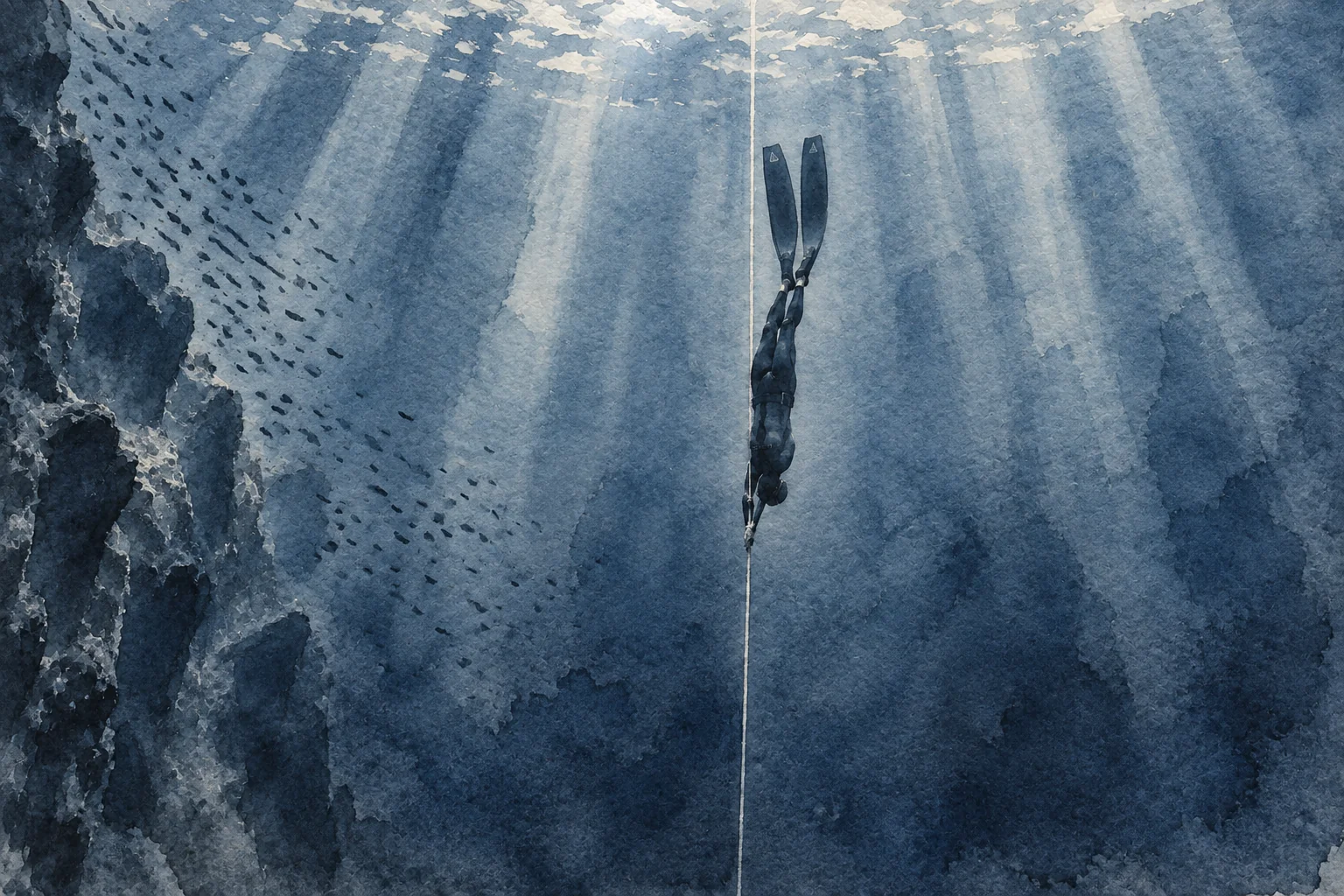
The iron vault of the deep closed shut.
Ⅳ. Ten Centimeters from the Nose, and the World Turned Gray
The first meters of the descent were far from weightless.
Positive buoyancy acted like invisible hands reaching from the seabed, shoving against my chest, violently resisting my progress into the deep. Every beat of the long fins was met with the heavy, viscous drag of seawater.
I became like a sharp steel nail driven by a hammer, or a sleek loach finding a hairline crack in mud. Through microscopic adjustments of the ankles and core, the body slowly unfurled into a hydrodynamic ribbon.
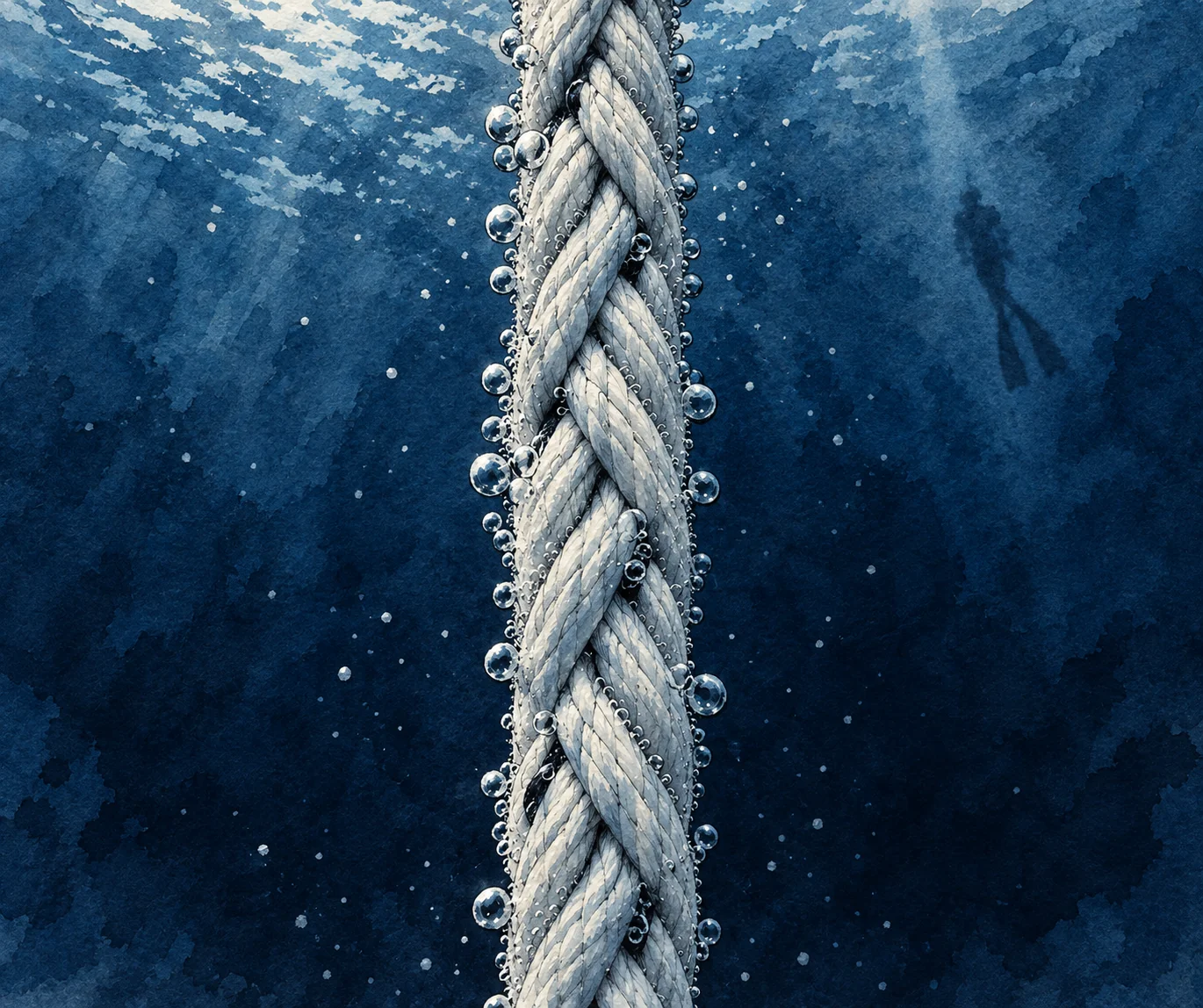
The guide line hung before me.
Just *ten centimeters* from the tip of my nose.
Vision was compressed to macro reality. I could see every coarse nylon fiber frayed by saltwater, every alternating segment of deep navy and bleached white ticking past my eyes at steady speed.
In the inner ear, a rhythmic, mechanical click sounded: Click... Click... The tongue acted as a piston, pumping minuscule volumes of air into the Eustachian tubes.
Throughout this passage, one iron rule governed existence: **Never look down.
Underwater visibility was barely fifteen meters. Looking down destroys the hydrodynamic alignment of the neck, compresses the carotid arteries, and disrupts cerebral perfusion. Worse, there was nothing to see—only a shapeless, dizzying void. To gaze into it was to invite the monster of vertigo back into the mind.
The universe was reduced to this ten-millimeter rope, trembling faintly with the distant pulse of surface waves thirty meters above.
Human nature carries a greedy impulse to crane our necks toward an unknowable horizon. Yet dozens of meters below, to look down is to face a lethal abyss of murk; to look up is to chase an unreachable sky. The only reality you can truly hold is this coarse ten centimeters of cord before your nose. In middle age, life often feels much the same: the road ahead is veiled in fog, the retreat behind is cut off. What one can do—and all one ought to do—is not be paralyzed by the vast unknown, but gather all scattered vanities, grip the singular roughness of the present inch, and descend quietly, inch by inch.
Ten meters. Twelve meters. Fourteen meters.
Hydrostatic pressure asserted its mathematical cruelty. The chest was compressed to half its surface volume, positive buoyancy collapsed, and the fin strokes turned effortless.
Then, at roughly fifteen meters, the body seemed to *shatter through an invisible pane of underwater glass*!
Resistance died. The neutral point was breached.
Negative buoyancy seized the flesh like an aquatic gravity beast.
Descent speed compounded instantly!
The alternating stripes of navy and white on the rope blurred under the sudden rush. Markings lost their borders, melting together in dynamic motion blur into *a single, streaming, flawless ribbon of pure gray*!
Freefall had arrived.
Ⅴ. Zero-G Body Scan, and the Ice Hole at Twenty-Four Meters
The legs went entirely dead.
Arms rested against the outer seams of the wetsuit. The chin tucked slightly, holding the perfect hydrodynamic line.
The entire Pacific Ocean, with its billions of tons of ancient mass, was drawing me downward like a falling star. In that effortless, weightless plummet, I closed my eyes and initiated a sacred body scan:
My neck... loose. My jaw... unclenched. My lips... resting like flower petals. My shoulders... sunken completely. My core... soft as water. My ankles... drained of effort.
The boundary of the physical body dissolved in the rush. All external noise had retreated past the horizon, leaving only the heart, tolling within the hollow cathedral of my chest like an ancient bronze temple bell:
Thump————* Thump———— *Thump————
Fewer than forty beats per minute. Each deliberate pulse metering out the final drops of oxygen to the brain.
Then, at twenty-four meters, an icy guillotine dropped without warning.
The Thermocline.
It was as if my head had plunged **straight into a colossal, subterranean ice hole!
The twenty-six-degree surface water vanished, replaced by an eighteen-degree shock of freezing liquid. It poured over my skull, washed across my brow, bit into my bare lips, and pierced the neoprene pores, stinging the chest, back, and fingertips like a million frozen needles.
The thermal shock triggered a mammalian convulsion: every skeletal muscle primed itself to shudder, clench, and brace!
It was a survival reflex etched across hundreds of millions of years of evolution.
Yet on the edge of the abyss, another voice spoke from the stillness of the mind—soft, steady, like a mother soothing a weeping child:
"Relax... relax... accept this cold."
Do not fight it. Treat it as the sea’s embrace. Cold is merely an electrical signal across nerve endings; let it wash through.
The sudden misfortunes, betrayals, or cold indifference of the world often strike like this thermocline—unreasonable and bone-chilling. The primal reflex is always to grit one’s teeth in fury. Yet the harder you rage, the deeper the frost drives into the marrow of your bones. The deep sea offered me an austere lesson: in the presence of irreversible cold, the most dignified way to live is not to shatter yourself against the storm, but to soften your shoulders completely. Let the freezing current pass through you; allow things to be temporarily contrary to your desires. Only then do you avoid burning your own oxygen in futile internal war.
Another miracle occurred.
Under conscious surrender, the clenched muscles of my back and chest relaxed like ice melting in warm tea. The freezing torrent continued to scour my bones, but my pulse did not skip a single beat.
With a softened, chilled vessel, I continued to fall into the black.
Ⅵ. Touchdown at Forty-Two Meters: The Paper-Thin Membrane
Deep in the dark, a tiny strobe light pierced the gloom.
At the bottom of the line, the safety strobe flashed like an orphan star, swelling larger with every second. Then, the heavy yellow bottom plate loomed into focus.
Speed decayed.
I extended my right arm, thumb and index finger forming a reversed ring slipping along the rope.
Clang.
My knuckle met the heavy, icy metal.
Forty-two meters. Touchdown.
I hung inverted beneath five atmospheres of absolute pressure.
Around me was the suffocating, velvety black of the deep ocean—a realm sunshine could never reach. The water pressure pressed against my ribcage like solid lead, shrinking my lungs into a hard core no larger than a fist.
In that frozen second, the most naked truth of human existence revealed itself:
Between myself and absolute non-existence, **there was nothing more than the paper-thin membrane of closed lips.
On land, life is insulated by towers of concrete, insurance policies, laws, and warm beds. But here, beneath millions of tons of water capable of pulverizing bone, the only boundary separating life from death was two wet, tightly sealed lips.
If my jaw twitched, if the throat seal failed for half a heartbeat, the high-pressure sea would obliterate my trachea and alveoli in an instant.
Simultaneously, the two-minute hourglass was bleeding dry. Every passing second meant an exponential collapse of oxygen. Every moment brought me closer to death.
Yet there was no time to philosophize.
Downward inertia was still dragging my frame deeper. My fingers snapped shut like steel jaws around the weight!
Using that downward momentum, my wrist flicked upward and around—the body followed the fluid dynamics, carving a magnificent, sweeping arc through the water.
Head to the sky. Fins to the abyss.
A flawless one-hundred-and-eighty-degree turn. Yielding to momentum, reversing destiny.
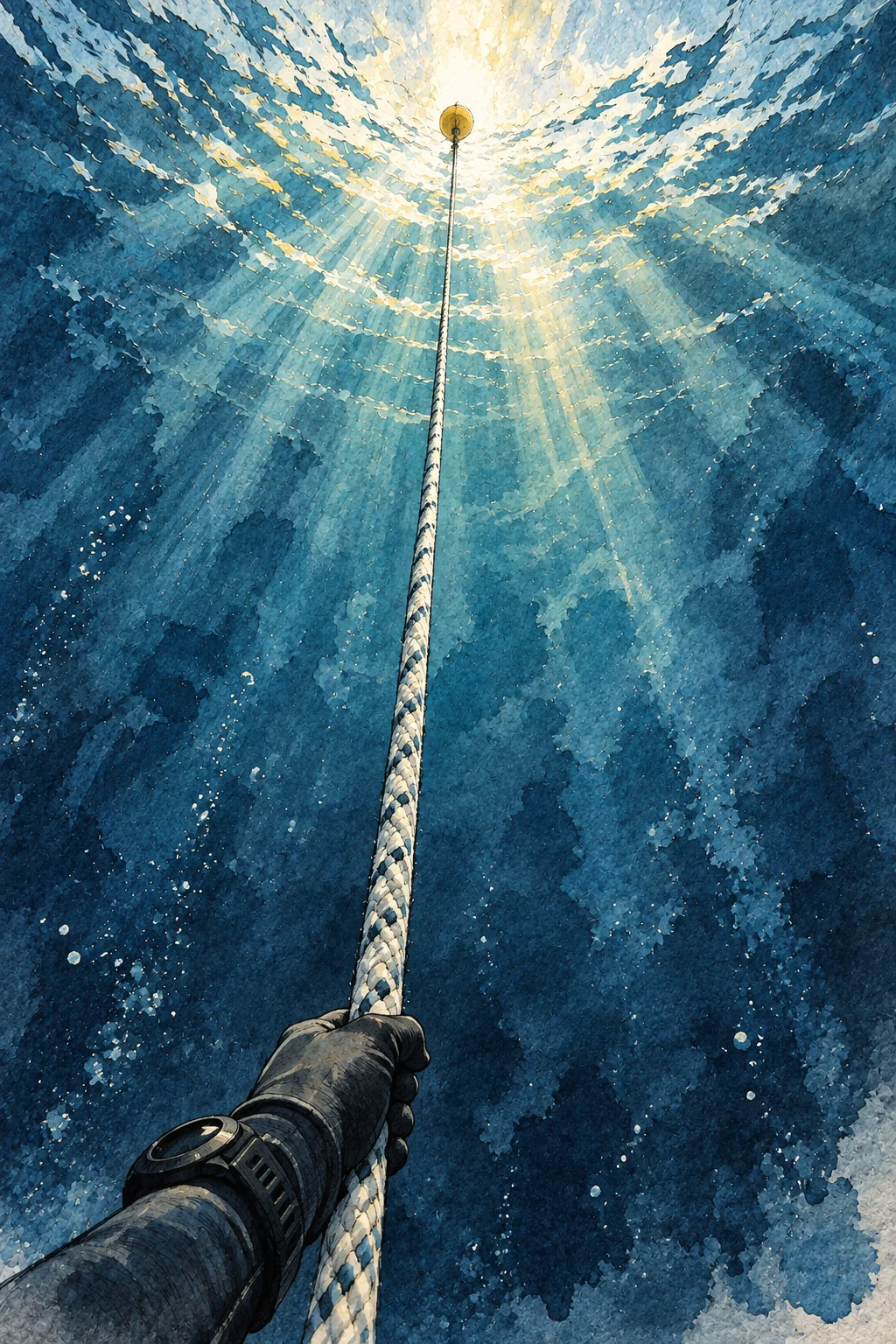
The ascent began.
Ⅶ. The Labor Pains of Ascent and the Guardian’s Gaze
If the descent was a dream of effortless falling, the first twenty meters of the return were a grinding, leaden purgatory.
Negative buoyancy became a cruel jailer, anchoring itself to my hips and ankles. With lungs compressed to a fraction of their volume, every downward kick of the carbon blades was an agonizing struggle against water density. Lactic acid flooded the quadriceps, burning like fire.
Inside the bloodstream, the real horror began.
Oxygen had burned down to ash. Carbon dioxide spiked, tipping the blood's pH balance and sending frantic alarms from the brainstem: Breathe! Inhale! Breathe now!
Thump!
From the floor of my chest, the diaphragm fired an involuntary, violent spasm (Contraction)!
Then a second. A third.
The spasms arrived faster, harder, shaking the internal organs as if trying to rip them loose. That tearing, rolling ache inside the viscera was precisely what female freedivers describe: **It was indistinguishable from the rolling contractions of labor.
The mammalian instinct was to clamp down, clench the jaw, and fight the spasm with every muscle fiber.
That was the direct road to death. Fighting contractions burns the final reserves of oxygen in ten seconds, pitching the brain directly into unconsciousness.
"Do not fight it. Let it contract. Receive it as you would a wave."
I opened my chest. With each violent heave of the diaphragm, I let my belly hollow inward without resistance; in the tiny, half-second pauses between spasms, I used raw willpower to slacken my jaw, neck, and shoulders even further.
Pain was everywhere, but the mind remained still as glass.
The travails of human life follow much the same law. Those dark, crushing passages that threaten to break the heart are rarely sent to destroy you; they are the emergency sirens sounded by life at its lowest ebb. If you treat pain as an enemy to be conquered, you reap only double the suffocation. Only by receiving it as a mother yields to contractions, allowing each wrenching spasm to ripple through, and granting yourself forgiveness in the pauses between agony, can you salvage that vital margin of survival in the blackest deep.
Ascending past twenty meters, the deep black cracked open into teal.
A long, elegant silhouette broke through the water above—my safety buddy! He pivoted gracefully two meters overhead, sliding into position beside me, hovering just fifty centimeters from my shoulder.
Our eyes locked.
Through the fogged lenses of our masks, I met his gaze. There was no panic, only fierce clarity, absolute focus, and wordless brotherhood. His eyes remained anchored to my pupils and mouth.
From twenty meters to the surface, hydrostatic pressure drops exponentially, the lungs re-expand, and arterial oxygen tension plummets off a cliff. This is the lethal threshold where ninety percent of blackouts strike.
Yet in those watching eyes, I saw an unbreakable sanctuary.
His gaze was an iron anchor, pinning my slipping consciousness to the mortal world.
Ⅷ. The Golden Shore: A Psychedelic Crossing
Yet in those training dives that tease the ragged edge of biology, when the final molecules of oxygen vanish from the cortex...
The veil of reality gently slips aside.
The uninitiated imagine Blackout as a suffocating nightmare of thrashing, choking terror. But those who have walked through it know that, under proper safety, it is a transcendent, psychedelic drift beyond the mortal shell.
The instant consciousness untethers, all pain vanishes.
The labor-like wrenching of the diaphragm, the burning lactic acid, the suffocation in the chest—every misery of this heavy, mortal body dissolves in an instant.
I felt my soul spread like ink dropped into a boundless ocean. Physical borders vanished. I slipped free of gravity, free of bone, light as weightless smoke.
I did not fall into cold, suffocating dark.
Instead, I crashed through a thin, shimmering membrane, falling upward into an *expanse of golden, warm, blinding light that brought tears to the eyes*.
It was a sublime feast of radiance.

Time stretched into eternity. In objective reality, it was merely three seconds of my buddy cradling my chin; yet in my internal world, it was an endless, sun-drenched afternoon.
On that shore of golden mist, every earthly shackle—mortgages, bills, aging, illness, fractured relationships, and human vanity—was stripped away. The air was warm as a newborn’s swaddle.
And deep within that light, I saw people.
Friends I had not spoken to in years; companions who had drifted away across the decades; loved ones who had long rested beneath the soil. They stood in the amber glow, dressed in simple, comfortable clothes, turning to smile at me.
We spoke without voices, yet our thoughts mingled with crystalline perfection.
"You came." "Yes. Just stopping by to see you."
We stood together on that field of honeyed sunlight, chatting lazily, as on every ordinary afternoon of youth. The atmosphere was soaked in compassion, peace, and absolute forgiveness. The serenity was so profound that I had no desire ever to wake again.
It was no hallucination; it was consciousness, freed from gravity, catching a stolen glimpse of the timeless peace at the root of being.
Ⅸ. Halos of Pink and the Rebirth Breath
"Jun! Wake up! Breathe!"
Two sharp, practiced taps struck my cheek, followed by warm breath blown across my eyelids.
The golden kingdom shattered into glittering glass.
Or, on the countless dives where consciousness held firm, crossing ten meters brought the sweet takeover of positive buoyancy. I ceased kicking entirely, allowing the sea to cradle my back like a colossal, tender palm, lifting me toward the sky.
The thermocline’s bite was gone; warmth returned.
Looking up, the noon sun illuminated the water from above, fracturing through the surface swells into billions of shimmering caustic rays, exploding at the edges of my vision into *dizzying, hallucinatory halos of rose pink, champagne gold, and diamond light*!
Whoosh—!
My face breached the water’s skin!
The cool sea breeze slammed into my forehead; the midday sun flooded my eyes; the sharp scent of salt, brine, and kelp rushed into my nostrils!
My sealed lips tore open, and the primal engine of the body unleashed a massive, guttural roar of life across the water—
"Hook Breath: HUUHH-HAAAH!!!"
That breath cleaved the dark like thunder.
Cool, wild, virgin air poured past the tongue and scorched throat, exploding into the starved chambers of billions of re-expanding alveoli!
In three seconds, desiccated capillaries were reignited with oxygen. A violent, golden surge of warmth raced down my spine to the tips of my fingers! The scalp tingled, the hands trembled, and every cell in the body screamed in pure, weeping ecstasy!
"I'm okay!"
Following protocol, my fingers locked into a firm "OK" sign, confirming clarity to my buddy.
Beside the float, the swell rolled on, ancient and unchanged. The warm sun baked against my wet cheeks, tender enough to break the heart.
Ⅹ. Epilogue: The Universe in a Grape
The steam had thinned away.
In the cafe, the jazz soundtrack had transitioned into a slow, smoky saxophone ballad. Across the street, a mother pushed a pram beneath the sycamore trees, amber leaves tumbling in the breeze.
David remained seated across the table, watching me with patient, fatherly warmth.
The black coffee was no longer scalding; a fine crema rested upon its dark surface.
I took a sip of the bitter, aromatic brew, looked at the old man, and smiled quietly:
"David, being down there... is very much like eating a single grape."
The old gentleman tilted his head, intrigued.
"When you strip the world down until only a ten-millimeter cord remains; when you compress all of your past and future into a single breath; when life and death hang by nothing more than the seal of two lips... your senses are wiped immaculately clean."
I turned the cup in my hands, gazing through the window at the drifting river of ordinary human lives:
"People think freediving is about conquering the sea, or proving courage to the crowd. It isn’t. It is an arduous inward pilgrimage.
In our youth, we imagine the meaning of life lies in 'more'—walking further, hoarding more medals, packing our calendar to the brim for fear of lagging behind in the secular race. Yet only after you have descended into forty-two meters of bone-chilling dark; only after you have survived the labor pains of your own flesh, and caught a stolen glimpse of that warm, golden shore at the edge of consciousness...
Only when you break the surface and pull that wild air back into your ribs do you finally understand:
To sit at this table, to smell this coffee, to watch the sun fall across dry autumn leaves, and to breathe freely upon this blue earth... is already the most unfathomable miracle ever given to us. Life, in the end, never needed all that clamor and clutter."
David stared at me for a long time, silent.
Then, the old man lifted his cup and touched it gently against mine in the quiet air.
The porcelain clink rang out in the afternoon sun, clear and resonant, like that first, newborn breath upon the sea.